Why do so many nomad maps get stale?
Adding a place usually feels like admin work. If the useful action takes too long, people do it once, maybe twice, and then the map slowly turns into old pins.
Why this can work
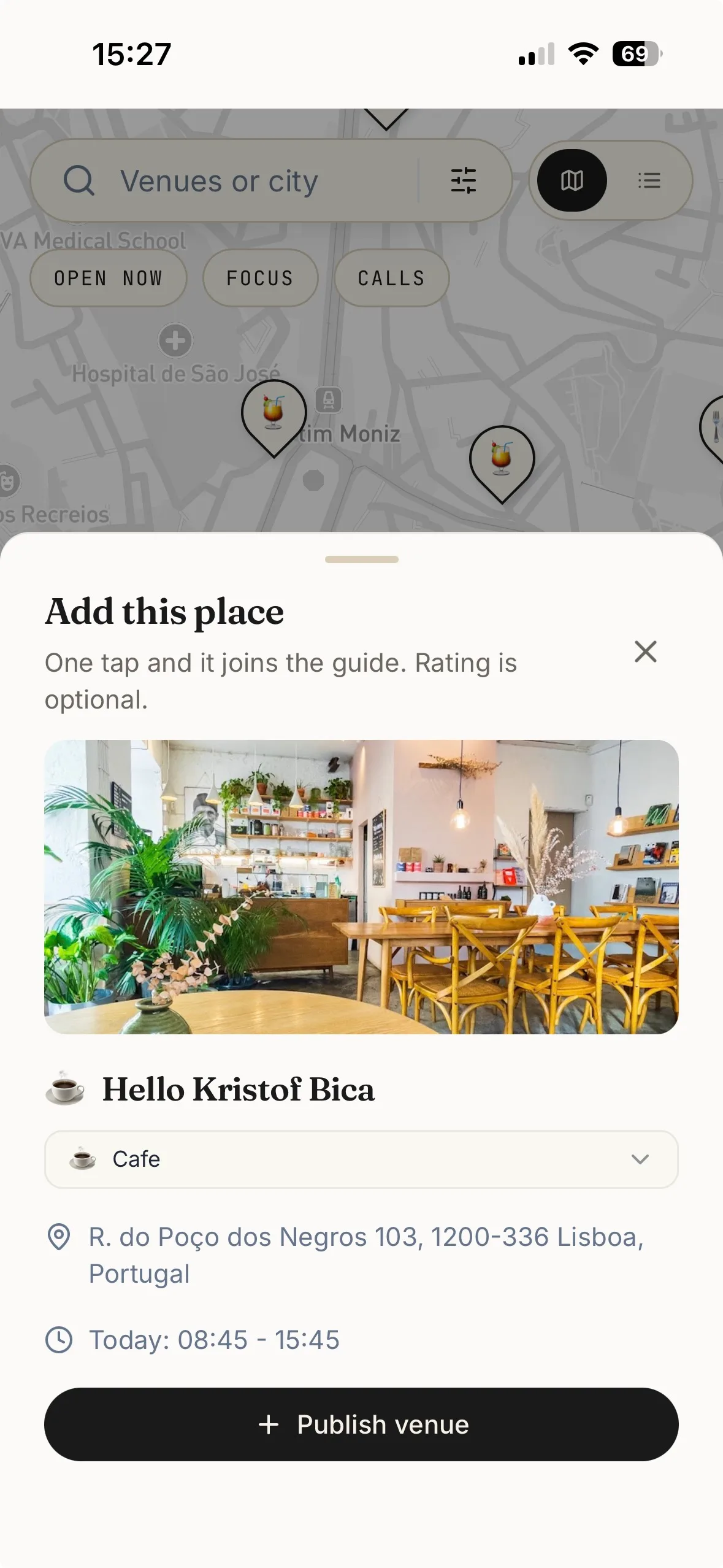
Nomad maps fail when adding a place feels like homework. NomadBadge keeps that step short: search Google, tap the place, and add the useful detail when you have it.
By Tim & Thomas 3 min read Updated 13 Jul 2026
2 steps
search Google, tap the place
0 forms first
rating should not block the add
1 real report
that is where trust starts
The short answer
The product works if contribution feels almost too easy. Add the place fast. Add the field report when you know something useful. Use AI for speed, but keep the proof human. That is the line.
The old failure mode
Most of them ask for too much effort before the user has seen enough value. The map might start well, then the fresh notes stop coming.
A remote worker may know a good cafe, coworking corner, library table, hotel lobby, or quiet bar. That does not mean they want to become a database clerk.
If adding a place starts with a long form, most people skip it. If reviewing asks for too much before they even trust the product, they skip that too. Then the map becomes what every stale guide becomes: a nice idea with old data.
NomadBadge has to stay closer to the moment. You just found a place. Search it, tap it, done. The extra detail can come later, when you know whether the WiFi, noise, outlets, and call situation held up.
Fast add loop
Search Google. Tap the place. That is enough to start a NomadSpot without pretending the review is already done.
Type the place name inside NomadBadge. The flow looks up the place instead of asking you to fill a blank form from memory.
Pick the right result and the useful shell is there. The first contribution should feel light enough to do while standing outside.
AI without the slop
In the speed layer, not the trust layer. AI can help us build faster. It should not invent proof.
A field report should come from someone who worked there, noticed the tradeoffs, and can say what held up.
Use AI for speed, structure, and boring build work. Do not use it to pretend a place has been tested.
Why the loop matters
A contribution loop has to be useful, but it also has to feel good enough that people repeat it.
The design matters here. A nice map, a quick add sheet, clean photos, and a useful field report do more than look polished. They make the next contribution feel less like unpaid work.
That is the part many products miss. Reliability is not only uptime and data. It is also the feeling that the product respects the few seconds someone gives it while they are between meetings, streets, trains, and tables.
The bar
Fast enough to add. Honest enough to trust. Good enough to come back to.
That is the version worth building before another big feature list.
FAQ
Adding a place usually feels like admin work. If the useful action takes too long, people do it once, maybe twice, and then the map slowly turns into old pins.
The add flow is built to be fast: search Google, tap the place, and move on. A rating is helpful, but it should not block the first useful contribution.
No. AI can speed up product work and help with rough structure, but it should not flood the guide with soulless imports. A place becomes useful when a real person adds context or leaves a field report.
Because the review is the trust layer. AI cannot know whether the WiFi dropped during a call, whether the room got loud after lunch, or whether the only outlets were already taken.
Open the app, add one place that actually worked, or leave one practical field report. The guide gets stronger through small useful actions, not big empty imports.
Try the fastest useful action
Search it, tap it, and leave the details when you have them.